$301,312
Revenue the deck projected for 2021 //
40 SolarCarts, 35,200 customers
$18,000+
Revenue the company earned //
2020 to 2022, company records
Both numbers describe the same company. The first is from the pitch deck Candela Energy sent to the Rockefeller Foundation and Acumen Academy's student social enterprise accelerator in 2020; the second is what it had earned by the time I left in August 2022.12 The periods differ, one year projected against two and a half years earned, and the gap is still about seventeen to one by my arithmetic. This thesis reads the deck the way I would read a stranger's today: which assumptions broke, why, and what that says about how distribution to India's villages gets built.
§ 01 //
Enterprises had the products and no way into the village
Candela began as a finding about distribution. In 2019 the founding team was working with Engineering for Change and MIT's D-Lab, and interviewed 23 social enterprises that made products for poor households: water filters, cookstoves, solar lights, toilets.1
Eighteen of them said the biggest threat to their solvency was selling in the last mile, the final stretch between a district town and a household that no shop, road or lender reaches on a schedule. Twenty-two said they would rather spend on the product than on selling it. Sixteen said villagers treated them as outsiders, and fourteen had closed down operations because their distribution did not work.1
The products existed. A filter that makes well water safe and a stove that cuts the smoke from a wood fire were already designed, tested and priced. The walk between the factory and the doorstep was what kept failing.
I ran partnerships at Candela from February 2020 to August 2022 and helped write the deck this thesis reads. The diagnosis in it held up. What we built on it is the subject of everything below.
§ 02 //
The cart sold access first so it could sell products second
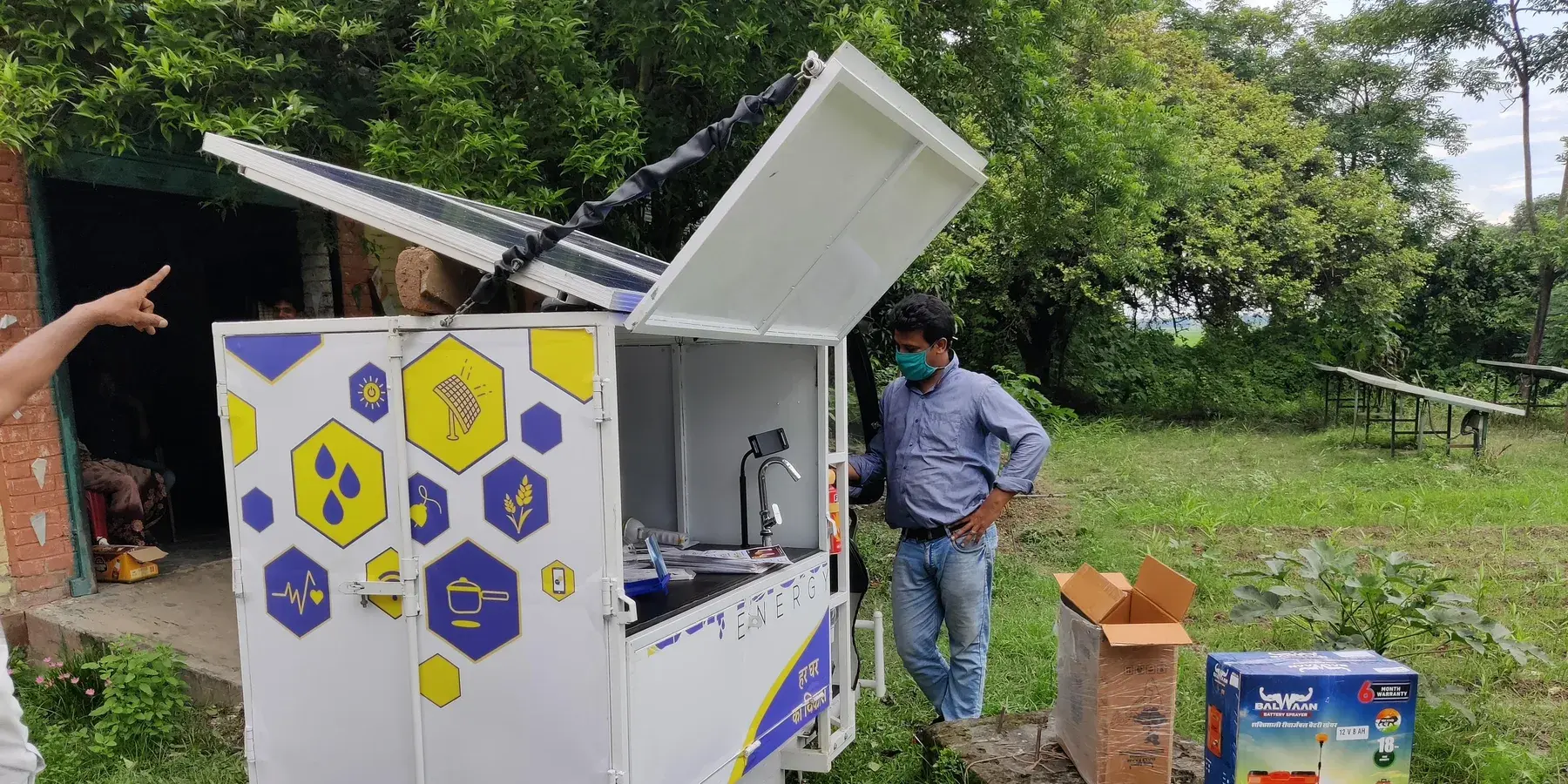
The SolarCart was a three-wheeled cart with a box body, a solar panel on its roof, and a tap, charging points and a WiFi hotspot inside.1 It sold three services by the unit: a litre of clean water, a full phone charge and 10 MB of data, each priced from willingness-to-pay surveys.
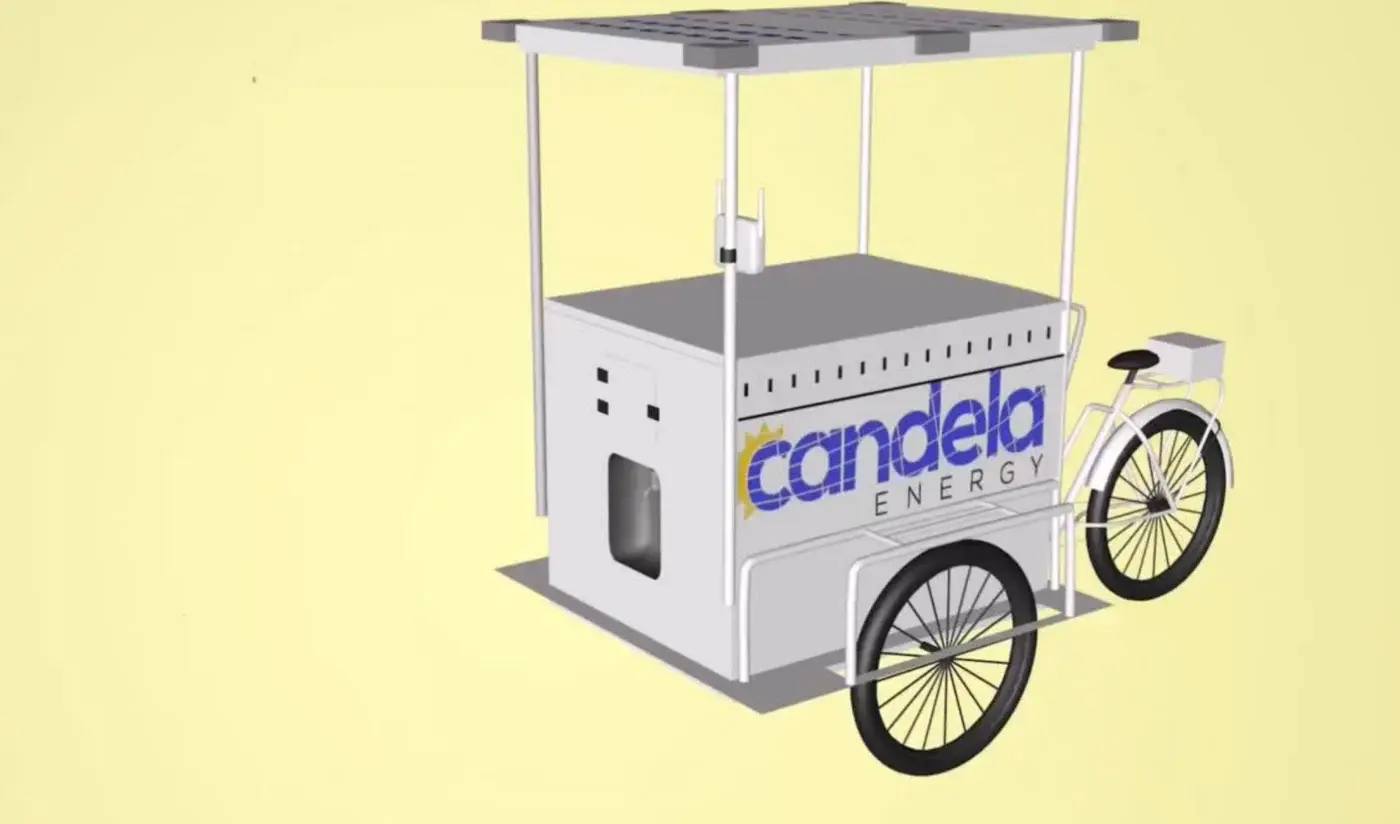
Behind the services sat a catalogue of products, sold on credit by a salesperson recruited from the same village. The deck listed two more revenue lines: data on what households bought, sold back to manufacturers, and the cart's panels sold as advertising.1
The idea underneath is the one a supermarket uses when it puts milk at the back of the store. Milk is bought often and earns little, so it goes where every shopper has to walk past everything else. The cart's water and charging were the milk. A household came for a litre, stood beside a working filter and a smokeless stove for a quarter of an hour, and some households bought one.
The analogy stops at the till. A supermarket shopper who buys milk also buys bread every week. The cart's other shelf held goods a household buys once in five years, and that difference decides the next four sections.
§ 03 //
Four hours outside a slum said people would pay
The first test ran for four hours in a peri-urban slum, cut short by COVID restrictions. Thirty-eight people stopped, and each spent almost fifteen minutes at the cart. Sixteen products went to eighteen people, because two neighbours split the cost of one water purifier. Seven used the pay-as-you-go services. Three asked whether they could lease the cart themselves, one of them a vegetable seller. The afternoon took $75.1
That is $18.75 an hour, or about two dollars for every person who stopped, by my arithmetic. Alongside it the team interviewed 138 people in rural communities, including by telephone in Bihar villages through a mini-grid developer, and 23 businesses. The lesson the deck drew was that households needed microfinance to bring down the upfront cost of products.1
One afternoon in one place is a sample of one, and a new machine on a street draws a crowd. It established willingness to pay. It said nothing about whether the same street would buy again the following week.
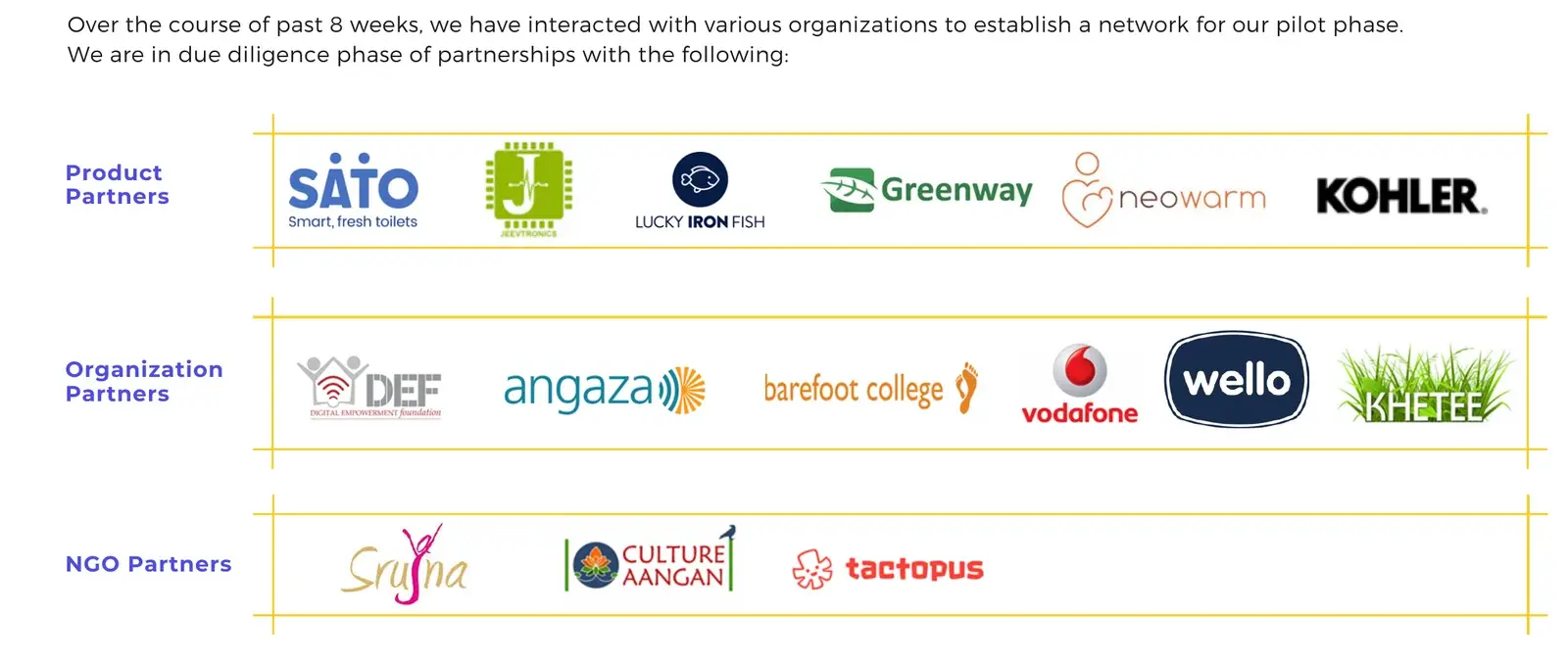
By the time the deck went out, the team was in diligence with fifteen organisations, from Kohler and SATO's toilets to Wello's rolling water drum, Lucky Iron Fish, Angaza's pay-as-you-go software and the Digital Empowerment Foundation's village network.1 None of them was a signed contract yet.
§ 04 //
Each product left two dollars for the company and two for the seller
The deck's unit economics start from the average sale.
Supplier //
$8, manufacturing, logistics and the rest
Candela Energy //
$2
Frontline seller //
$2 commission
The deck describes the company's share as a 20% mark-up on the wholesale price: on a product retailing at $10, Candela keeps $2.1 The split above is the deck's own worked example at the average sale of $12.
The cart itself cost $500 to build and $450 a year to run, and the person staffing it was budgeted $250 a year. The deck put payback at seven months.1
That holds up. Recovering $500 at $2 a product takes 250 sales, or about 36 a month over seven months. The running cost and the salary add $58 a month, which is another 29 sales. Call it 65 products a month, roughly two a day, by my arithmetic. Against an afternoon that sold sixteen in four hours, two a day was an easy number to believe.
§ 05 //
The seller was budgeted an eleventh of what keeps a seller
The cart breaks even at two sales a day. The person running it stays only at four.
The best public evidence on this comes from the Global Distributors Collective's 2019 survey of 72 last-mile distributors in 30 countries. Citing research by Hystra across 50 distributors, it puts the floor at about $8 a day for a full-time agent, or $2,850 a year. Below that, agents leave, and the main reason distributors give for losing agents is that they did not earn enough. Distributors cannot sustainably pay more than about 20% of revenue to agents, so a full-time agent needs at least $14,000 of sales a year.3
The deck paid the cart's seller $250 a year plus $2 a product. $2,850 is about eleven times $250. To close that gap at $2 a sale, the seller needs about 1,300 extra sales a year, around 108 a month, or four every working day, by my arithmetic.
So the seven-month payback was correct and incomplete. It paid back the metal. The cost that decides whether a distribution network survives is the person, and the deck priced the person at an eleventh of the going floor.
§ 06 //
A village buys a water filter once
The obvious explanation is that door-to-door selling in rural India does not pay. It pays well for one company.
Hindustan Unilever's Project Shakti runs the same channel Candela proposed, women from the village selling to their neighbours, through more than 1.9 lakh sellers across 18 states, with each of its rural sales promoters managing a network of 30 to 35 of them.4 The channel is identical. The difference is in the bag. A Shakti seller carries soap, shampoo and tea, which a household buys every month. Candela's seller carried a water filter, a cookstove, a solar lamp and an iron fish that a family drops into the cooking pot for years.
A filter sold is a customer finished. Each sale uses up a little of the village, so the cart has to keep moving to villages where it has no trust yet, and the first demonstration in a new village is the most expensive sale it makes.
The survey shows distributors living with this. More than half sell several product categories, because breadth is how they pay for distance in thinly populated areas. Among the fast-growing ones, 60% sell a single category.3 Breadth pays for the road and focus is what grows.
Price was squeezed from the other side. A Rotary chapter buys Wello's WaterWheel at a discounted ₹2,100 and hands it to women for ₹100.5 A commercial distributor selling the same drum at a margin is competing with a donor a few villages away.
§ 07 //
The state began giving away the milk
The services that were meant to bring households back every day became cheap or free while Candela was being built.
Mobile data fell from ₹269 a gigabyte in 2014 to ₹11.78 in 2018, about 96%, with the steepest fall after Jio launched in September 2016.6 The Saubhagya scheme connected 2.82 crore households to the grid between October 2017 and March 2021.7 Rural households with a tap at home rose from 16.7% in August 2019 to 80% in March 2025 under the Jal Jeevan Mission.8 Ujjwala had handed out 10.15 crore LPG connections by January 2024.9
Each of these was a sound policy choice, and each took away a reason to walk to the cart. The charge, the litre and the megabyte were arriving at the door through the state and the telecom market.
§ 08 //
The projections multiplied the one number with no evidence behind it
The deck projected 40 carts in 2021, 100 in 2022, 250 in 2023 and 750 in 2024.1
2021 //
$301,312 from 40 carts, a loss of $31,128
2022 //
$879,284 from 100 carts, a profit of $22,707
2023 //
$2,597,091 from 250 carts
2024 //
$9,437,731 from 750 carts, a profit of $1,008,751
Customers served rise from 35,200 to 900,000 over the same years. Bar lengths are revenue as a share of 2024.1
Every line grows with the cart count, and the cart count was the number with the least evidence behind it: one machine, one afternoon. The per-cart figures are modest. Revenue in 2021 works out to $7,533 a cart, about $628 a month, and $8.56 a customer, less than one product each, by my arithmetic.
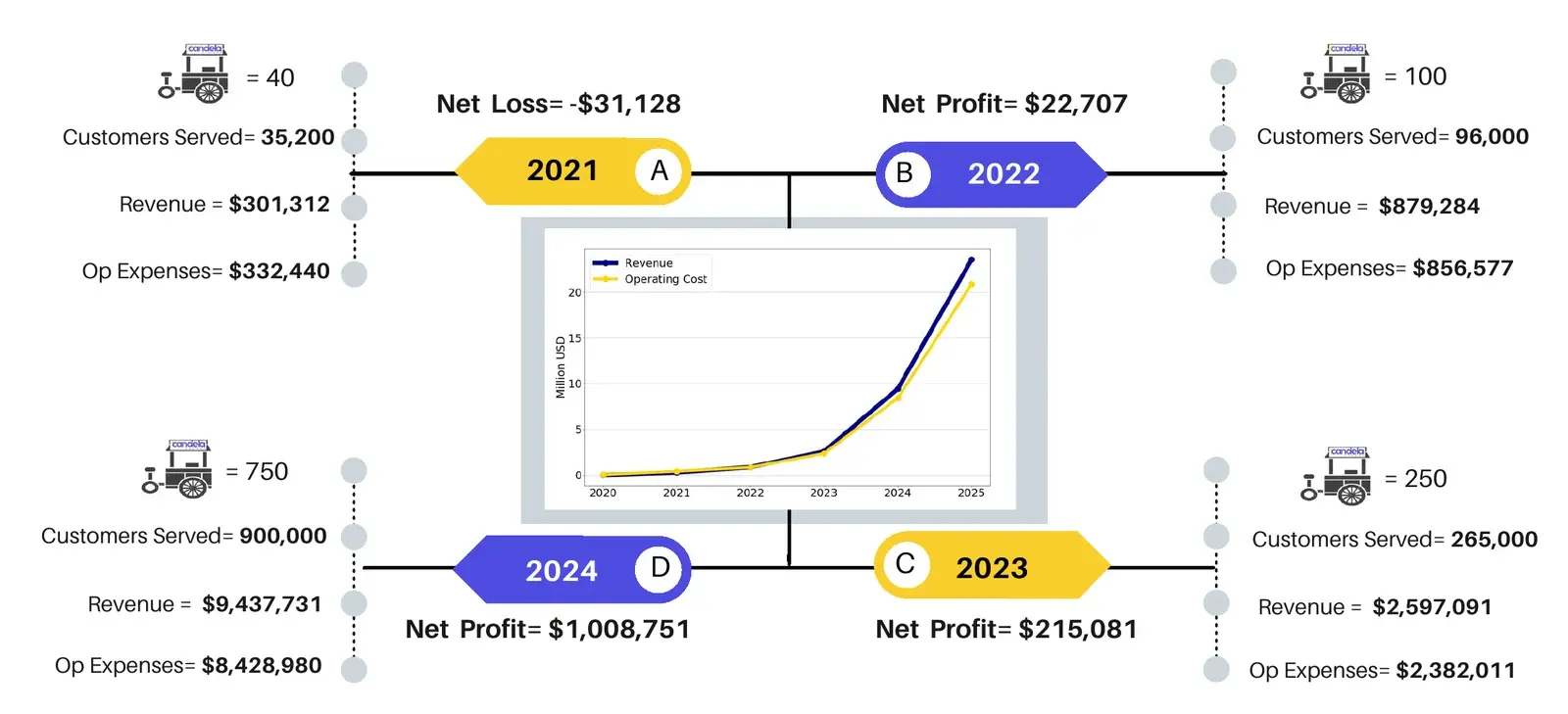
The cost line says more. Operating cost in 2021 comes to $8,311 a cart, against $700 of running cost and salary at the cart in the unit economics. About 92% of projected cost sat above the cart, in the warehouses, managers and marketing that a network needs, by my arithmetic. A cart that pays back in seven months carries a company that does not.
The deck also contradicts itself in places. The accelerator money buys ten carts on one slide and forty on another. The ask runs to breakeven in month 24 or 25, while the projection shows a profit in 2022. A milestones table repeats 35,200 down every row, placeholder figures left in.1 These are the slips of a deck a four-person founding team wrote around an accelerator deadline, and they matter less than its structure.
§ 09 //
The shop beat the cart
What happened next was recorded in the company's own numbers. The team grew from five to fifteen and built a network of more than 25 small-business partners. It raised more than $10,000 in grants through competitive pitches. A pilot at a fixed shop in a high-footfall area produced the lowest cost of acquiring a customer the company measured, and kept customers better than the mobile kiosk did. Customers paid for solar cookstoves and bio-alternatives in a segment everyone described as too price-sensitive. Revenue passed $18,000.2
A shop has an address. A buyer can come back to it with a complaint, an instalment or a neighbour. A cart is somewhere else by evening, and trust in a village attaches to a place and a person who will still be there next month.
Three of the companies on the deck's competitor slide found the same thing. Essmart, founded in 2012, sells durable goods through village kirana shops: about 600 in 2018, when it raised $1.2 million, and nearly 5,000 by 2022, with more than 400 products and Essmart handling sourcing, delivery and after-sales service.10 Frontier Markets has onboarded more than 35,000 rural women as sellers who take orders through an app.11 Pollinate Group trained more than 900 women to sell in urban slums.12
Each of them borrows trust that already exists, a shopkeeper's or a neighbour's, and adds the catalogue, the delivery and the repair. None of them owns the vehicle.
§ 10 //
The five things I look for in last-mile distribution
| What | Why it is open | What exists in India | What I ask to see |
|---|---|---|---|
| A repeat purchase in the basket | A durable sold once uses up a village; Shakti works on goods bought monthly | Shakti's 1.9 lakh sellers; Frontier Markets' mixed catalogue | Share of revenue from customers who bought before, by month |
| Seller earnings above the churn line | Agents leave below about $2,850 a year, which needs $14,000 of sales | Commission-and-salary networks; women's seller networks on apps | Seller income distribution and twelve-month retention |
| Trust that already exists | The fixed shop beat the cart on acquisition cost and retention | Essmart's kirana network of nearly 5,000 shops | Acquisition cost by channel, measured the same way |
| Credit priced into the product | Financed products sell at about 20% more, defaults average 8% | Microfinance, Airtel Payments Bank, women's credit programmes | Default by monthly cohort, and who carries the loss |
| Stock on supplier credit | Only 5 of 72 distributors surveyed had it; imports run 50% on order | Large brands extending terms to strong distributors | Days of inventory and payment terms by supplier |
§ 11 //
Three things I pass on
01 // Distribution built on a vehicle the company owns
Every cart is capital parked in one village at a time, and the village shop is already there.
02 // Footfall from services the state now supplies
Tap water reached 80% of rural households and data fell 96% in price, so a business that needs people to queue for water or a charge is waiting on a queue that is going away.
03 // A catalogue wider than the seller can explain
Essmart's co-founder Jackie Stenson put it plainly: if shop owners cannot answer questions about a product, they will not feel comfortable selling it.10
§ 12 //
What would change this thesis
One result would confirm it: a distributor that holds its sellers above the churn line for two years while selling one category through shops it does not own.
Until then the measure is the opening pair. $301,312 projected for one year against a little over $18,000 earned in two and a half is what one cart could not carry: a seller's living wage, a village that buys once, and services the state was about to deliver to the door.