61
Foreign customer satellites on PSLV //
Launched by NSIL, ISRO's commercial arm, to April 2026
2
Indian customer satellites on PSLV //
Over the same period
ISRO's commercial arm, NSIL, has launched 61 satellites for paying international customers on its PSLV rocket, and two for Indian ones.1 Between 2015 and 2024 India put 393 foreign satellites from 34 countries into orbit, 232 of them American.2 In December 2025 its largest rocket carried the heaviest payload it has ever lifted, a broadband satellite of about 6,100 kg built by AST SpaceMobile, an American company.3 India's workhorse rocket has had thirty times as many foreign paying customers as Indian ones. Part of that is history, since until 2020 an Indian private company could not legally build and own a satellite.4 The rest is what this thesis is about: who pays for Indian space, what India makes that the world will buy, and where a venture investor fits in between.
§ 01 //
Three claims carry this thesis
1/ Indian space earns from the world first. The paying customers are foreign operators and foreign governments. At home the buyer is still the state, and the commercial anchor that would change that, a large Indian constellation, has not been committed.
2/ India's advantage is the cost and depth of its engineering, and it travels best as a launch sold to someone else, a satellite built to order, a sensor or a part. It is weakest where scale sets the price: a small rocket against a SpaceX rideshare, or a broadband constellation against Starlink.
3/ Most of the money in space is made selling to people on the ground, and Indian venture capital went mostly into rockets and satellites. The companies that sell an answer, such as which fields flooded last night, are early, and a 12-satellite public-private constellation is about to put more Indian raw data on sale.
The rest of this page tests those claims in the order a buyer meets them: how the industry is put together, who pays, what India makes segment by segment, and what each segment costs to build. The load-bearing claim is the first. The closing sections set out the open questions on regulation, capital and demand.
§ 02 //
Space is on its third start, and India arrived with a record
Space has started three times, and each start was set by who paid. Governments racing each other paid for the first, from Sputnik in 1957 to the Moon in 1969. Governments cooperating paid for the second, alongside the first private owners of communication satellites. The third start belongs to private companies that made getting there cheap, with reusable rockets, satellites under 100 kg and constellations of thousands.
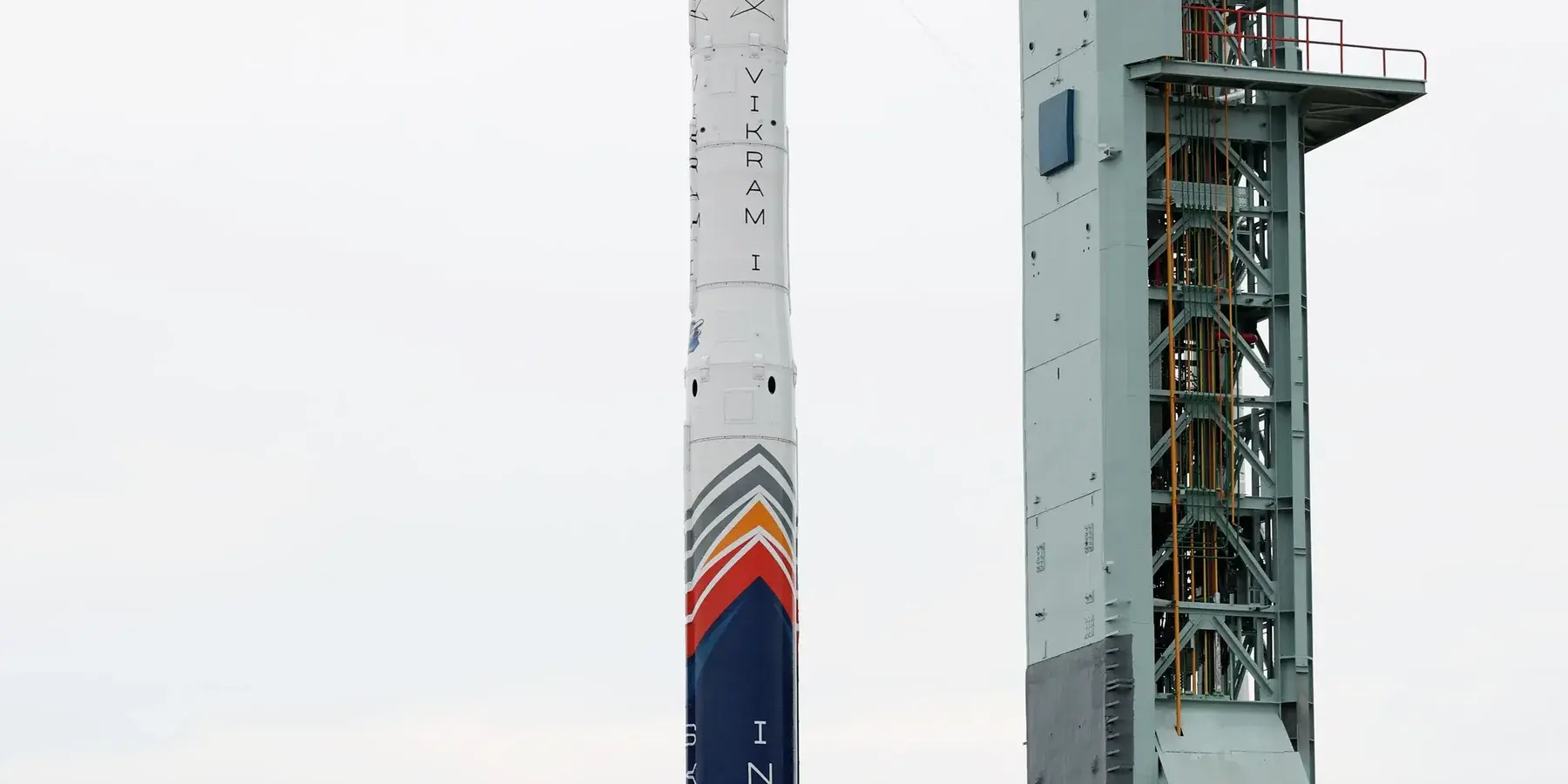
India's science record is why the world takes its engineering seriously. Chandrayaan-3 landed near the Moon's south pole in 2023, the first craft to do so; Aditya-L1 has watched the Sun from 1.5 million km since 2024; and SpaDeX made India the fourth country to dock two satellites in orbit, in January 2025.5 In July 2026 Skyroot's Vikram-1 reached orbit on its first attempt, which made India the third country, after the United States and China, with a private company able to reach orbit.67
The private sector was let in by decision. For fifty years ISRO ran a closed system in which private firms supplied parts and the agency did the rest. In 2020 the government created IN-SPACe to authorise private space activity, and a 2023 policy lets private firms build, launch and operate end to end.8 By August 2026 India had about 440 registered space startups.9
§ 03 //
Space is four businesses stacked on top of each other
The space industry is four businesses, and the two that sell to people on the ground earn almost all the money. The commercial satellite industry earned $303 billion in 2025, out of a $429 billion space economy in which governments' own budgets make up the rest.10
Ground equipment //
$165.2 billion; dishes, terminals and navigation chips
Satellite services //
$105.0 billion; broadband, TV, imagery, data
Satellite manufacturing //
$20.4 billion
Commercial launch //
$12.4 billion
Shares of $303 billion are my arithmetic from the Satellite Industry Association's 2026 report.10
At the bottom of the stack sit the builders: satellite makers, their parts suppliers and the launch companies that fly them. They earned $20.4 billion from satellites and $12.4 billion from commercial launches in 2025.10 Above them sit the operators, who own satellites and sell what they produce, whether bandwidth, television channels or pictures; satellite services earned about $105 billion.10 Then the ground segment: dishes, terminals, receivers and the navigation chip in every phone, which earned $165.2 billion, most of it from GPS-type devices.10 At the top sit applications, the software that turns a signal or a picture into a decision a customer pays for.
Launch, the part everyone films, is about 4% of commercial revenue by my arithmetic. The bulk goes to whoever owns the customer at the end of the chain. Elevation Capital's 2024 map of the industry, whose structure this thesis follows, drew the same shape from earlier figures.11
§ 04 //
Where a satellite sits sets what it costs and who buys it
A satellite's orbit decides its size, its price, its life and its customer. Low Earth orbit, or LEO, runs up to about 2,000 km, and a satellite there circles the Earth in about 90 minutes.12 Close to the ground, a camera sees fine detail and a signal arrives in a few hundredths of a second, so imaging and broadband satellites live there. The catch is coverage. Each satellite passes over a place for minutes, so continuous service needs hundreds or thousands of them, and drag pulls the lowest down within about five years.
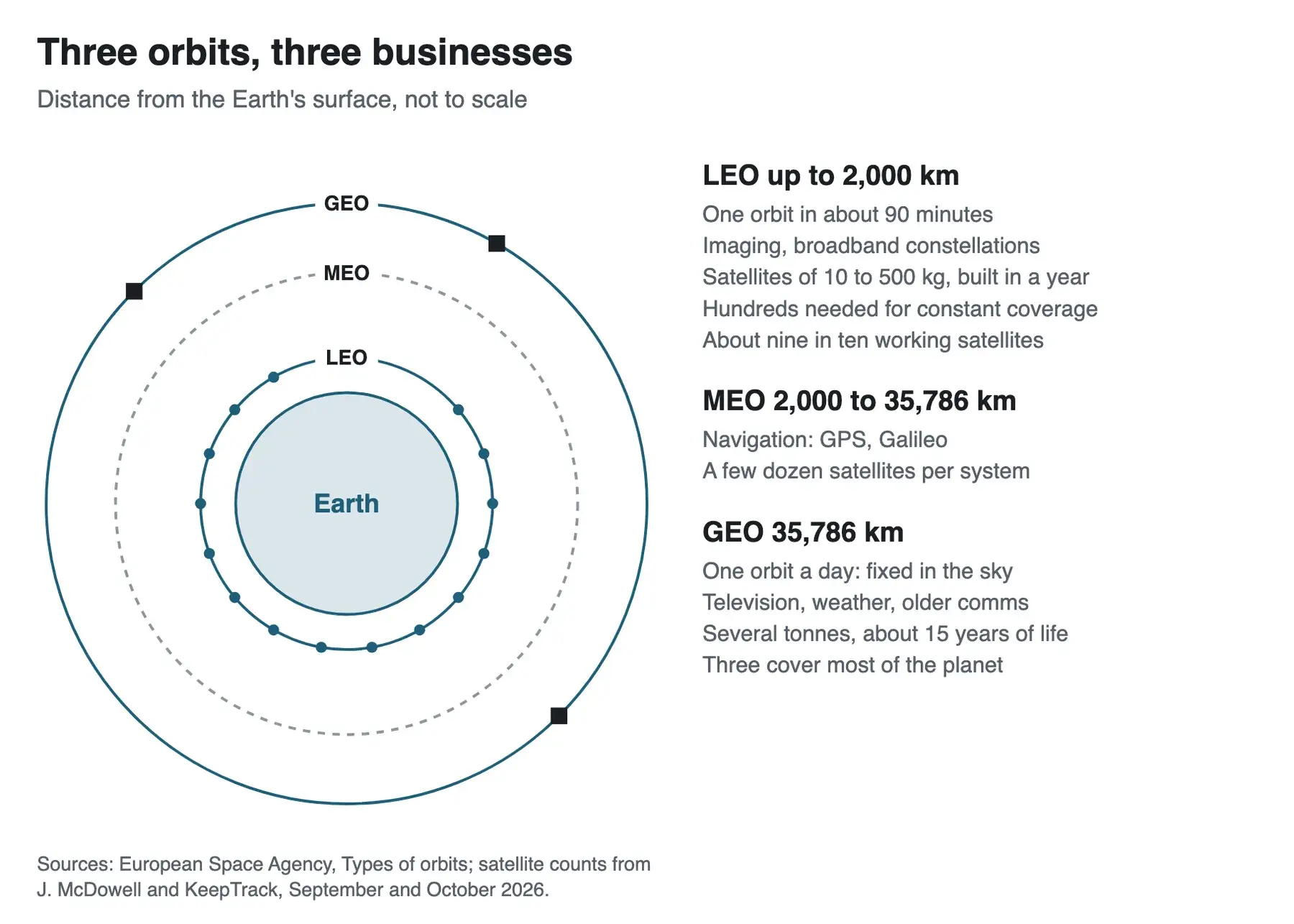
Geostationary orbit, or GEO, sits 35,786 km above the equator, where a satellite takes a day to circle the Earth and so hangs fixed in the sky.12 Three can cover most of the planet, which is why television and weather satellites use it. A GEO satellite weighs several tonnes, costs hundreds of millions of dollars, lasts about fifteen years, and is bought by a large operator or a government. Medium Earth orbit, in between, is mostly navigation.
The industry has moved low. About 16,900 satellites were working in September 2026, two-thirds of them Starlink's, and almost nine in ten sit in LEO.13 That shift opened space to startups, because a 100 kg LEO satellite costs a small fraction of a GEO one, can be built in a year and can be replaced when it wears out.
§ 05 //
The money went up, and the revenue stays on the ground
Venture investors put most of their money into hardware that goes up. Private investment in space companies reached $12.4 billion in 2025, up 48%, and the United States took 60% of it.14 Investment in data and analytics companies fell in the same year, and none of them raised a round above $100 million.14
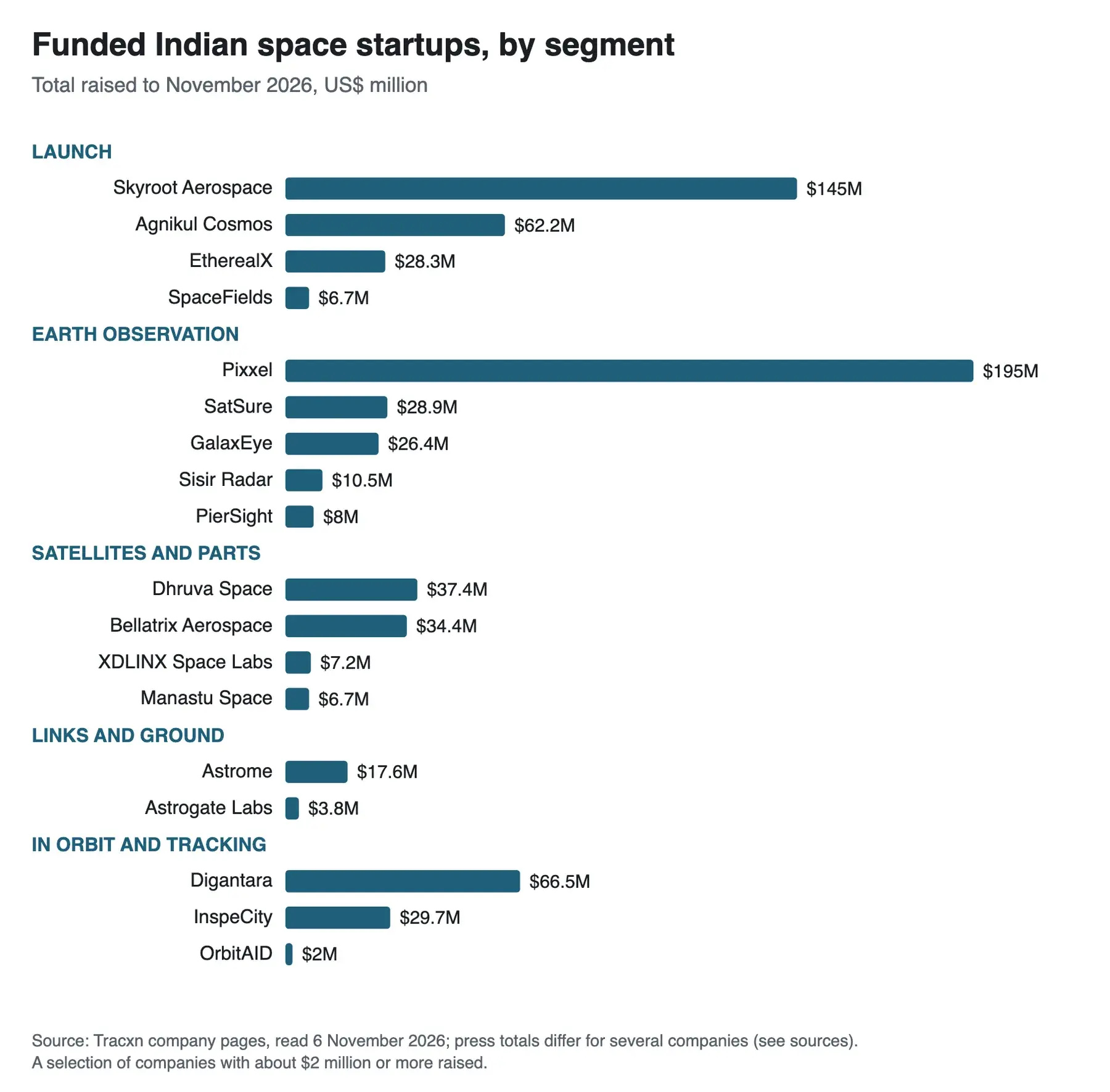
India repeated the pattern. Most funded Indian space startups build satellites or rockets, while downstream applications are about 70% of commercial space activity worldwide.8 The ten best-funded hold more than 60% of all the money the sector has raised.15
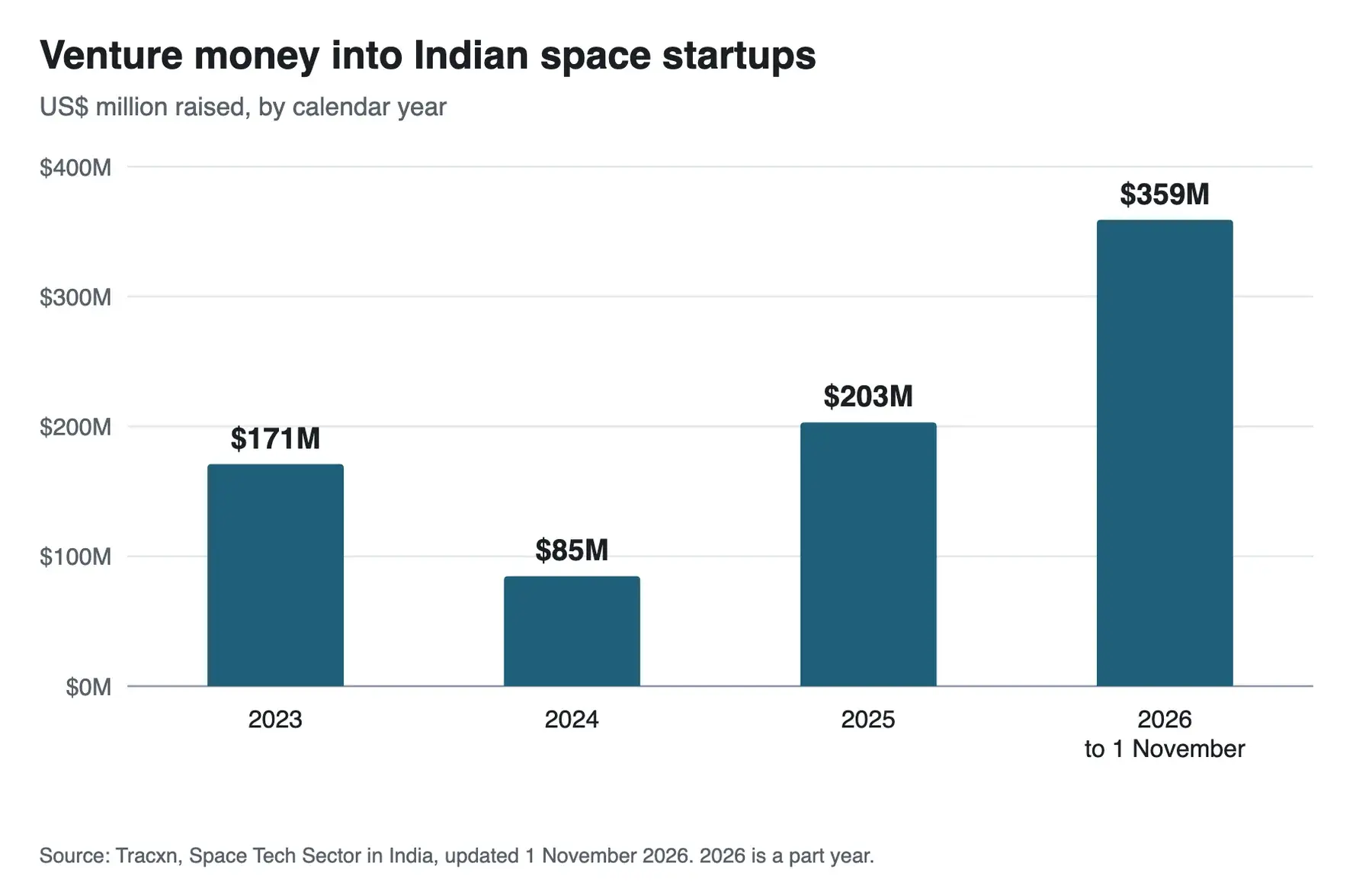
Indian space startups raised $171 million in 2023, $84.6 million in 2024, $203 million in 2025 and $359 million in 2026 to the start of November, so 2026 is already the largest year on record.16 Pixxel's $100 million Series C in September was the largest single round.17
Why fund the smallest pool? Because whoever controls the ride to orbit decides who flies and when, and SpaceX turned that control into Starlink, which earned $11.4 billion of SpaceX's $18.7 billion in 2025.18 The hardware bet pays when it ends in a service, and only at that volume.
§ 06 //
Almost every buyer in space is a government
The commercial customer that space investors expected has mostly not arrived, and governments pay for most of what gets built. Governments spent $137.4 billion on space in 2025, about 54% of it on defence.19 Planet Labs, which photographs the whole Earth every day, earned $307.7 million in the year to January 2026; 59% came from defence and intelligence customers, and its commercial revenue fell for the second year running.20
The obvious answer is that commercial demand needs only cheaper satellites to show up. The founders closest to it disagree. "Commercial demand is quite insignificant at this point in time for everybody," Digantara's founder Anirudh Sharma said in August 2026.21 Digantara set out to map satellites and debris for commercial operators; after a $50 million Series B in December 2025, its US arm works on American missile defence.22 The sensor that tracks a dead satellite also tracks a missile, and the missile customer pays.
Satellite broadband is the large exception. Its subscribers grew 62% in 2025 to more than 10 million.10 But that market needed hundreds of satellites in orbit before it earned a rupee, an outlay only SpaceX and Amazon have made, so its capital sits outside venture scale.
So the question for an Indian space company is which government it sells to, and whether it can sell the same thing to a second one abroad.
§ 07 //
India already sells launches to the world
India's launch business has served foreign customers for twenty years, and it is growing again. Between 2015 and 2024 India launched 393 foreign satellites and earned about $143 million and €272 million doing it, roughly $44 million a year by my arithmetic.2 That is a small business beside NSIL's revenue, most of which comes from leasing satellite capacity to Indian broadcasters, and it is the base the next decade builds on. NSIL holds two dedicated PSLV contracts with international customers, about twenty smaller satellites booked as co-passengers, and a dedicated contract for its small rocket, SSLV, with an Australian customer.1
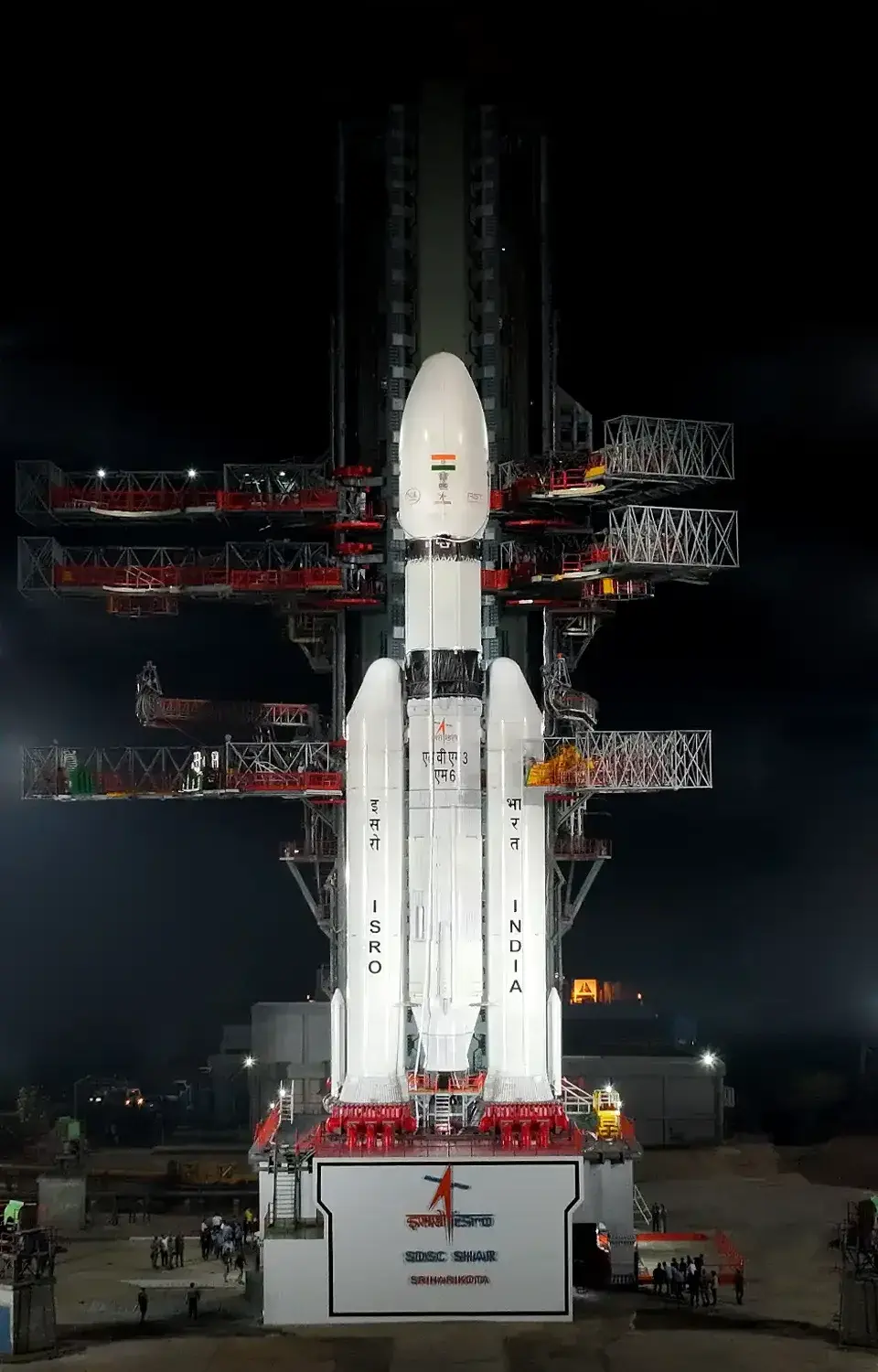
The heavy rocket now flies for foreign companies too. In November 2025 LVM3 carried CMS-03, at 4,410 kg the heaviest communication satellite sent to high orbit from India, and 52 days later it flew AST SpaceMobile's BlueBird on a commercial contract.13 NSIL is in talks with international customers for dedicated LVM3 flights through 2028.1
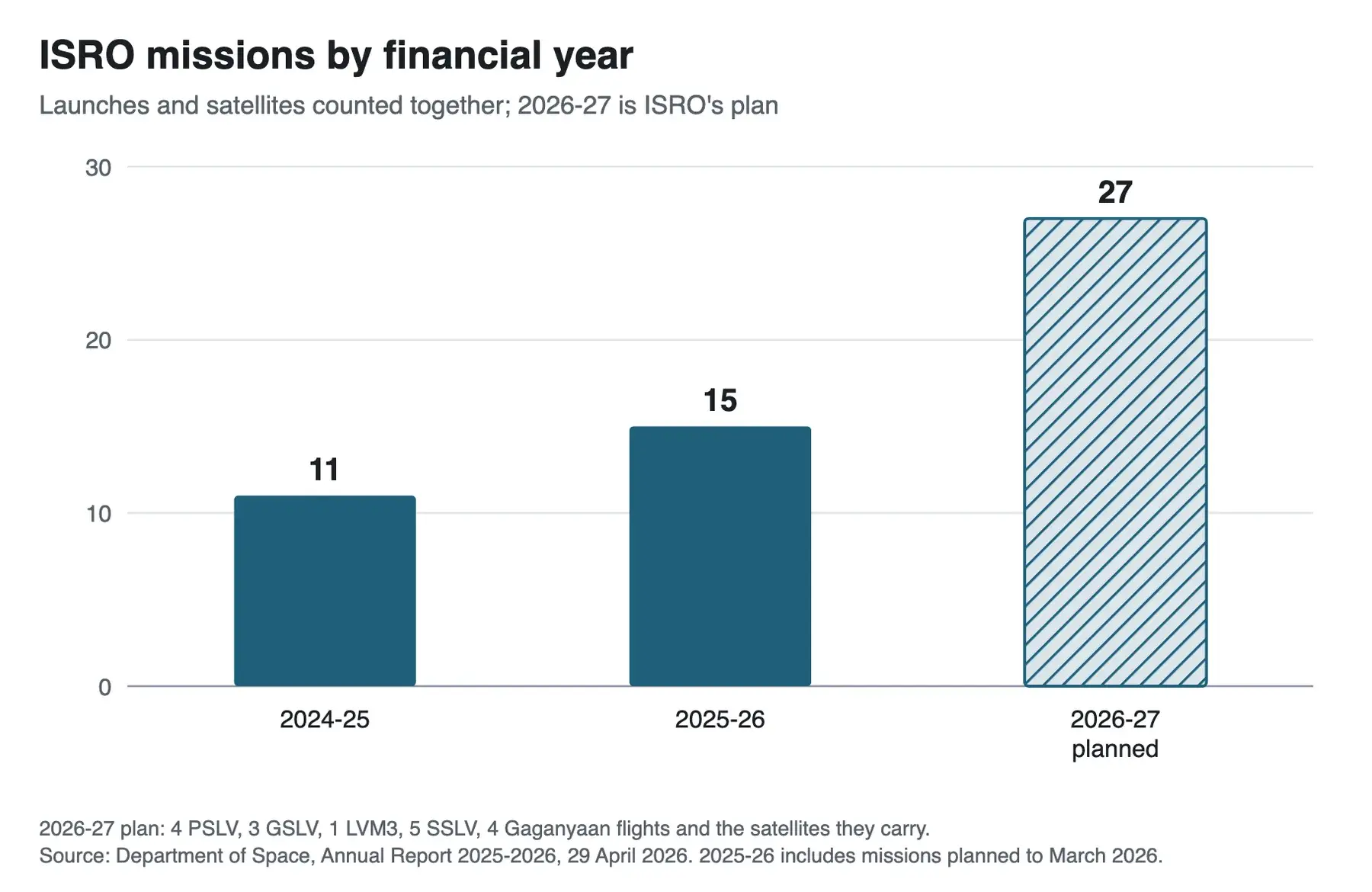
The schedule is growing to match. Counting launches and satellites together, ISRO had 11 missions in 2024-25, planned 15 for 2025-26 and plans 27 for 2026-27.1 Two PSLV failures in eight months, in May 2025 and January 2026, show the strain.23 The state is also handing its rockets to industry: HAL bought the SSLV technology for ₹511 crore, NSIL is buying 15 SSLVs from Indian vendors, and a HAL and L&T consortium is building five PSLVs, the first reportedly slipping to March 2027.123
§ 08 //
A private rocket in orbit is a pricing problem
Vikram-1 answered the engineering question and left the commercial one, which is a price. Skyroot was valued at $1.1 billion after its Series C in May 2026, and its factory was designed to build one orbital rocket a month.2425 Its published rideshare price is $10,000 to $12,000 a kilogram.26 A seat on a SpaceX rideshare, where dozens of satellites share one rocket to a common orbit, costs $7,000.27 SpaceX flew 165 of the world's 325 orbital launches in 2025 and carried 85% of the satellites.28
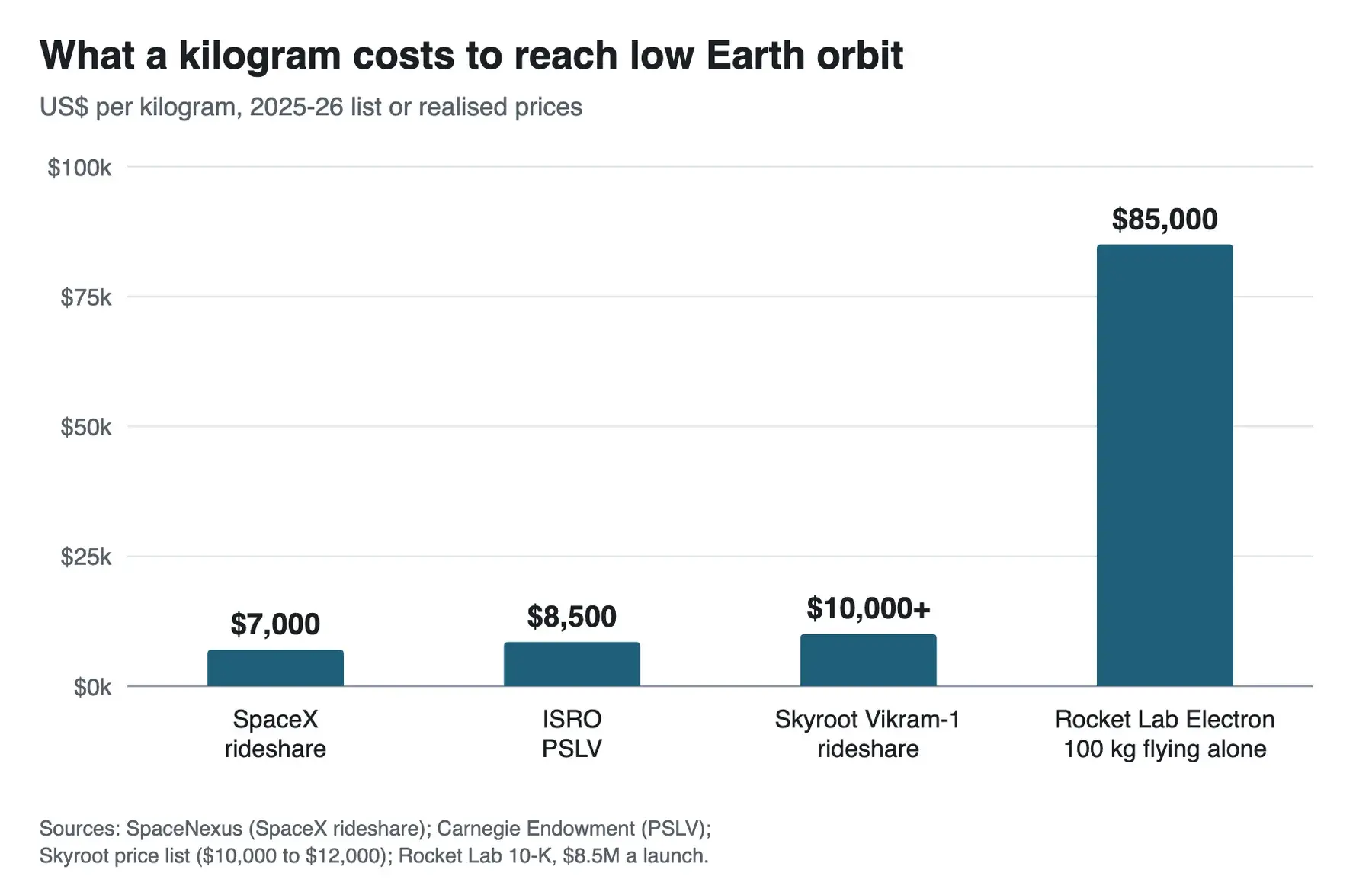
A small rocket cannot win on cost. It wins on schedule and orbit: a satellite that must reach a particular orbit next month, a defence payload that cannot ride with strangers, a constellation replacing a lost slot. That market is real and narrow. Rocket Lab flew 21 missions in 2025 at about $8.5 million each and still made 67% of its revenue building satellites and parts.29 Astra went public at about $2.1 billion and was taken private at 50 cents a share.30
Agnikul, India's other funded launch company, has flown a suborbital test and holds a ₹200 crore government agreement to build a reusable rocket.31 EtherealX raised a $20.5 million Series A in January 2026 for a reusable medium-lift rocket.32 HAL's state-backed SSLV will chase the same customers.
§ 09 //
India's edge is cost, and the state has started buying
India builds space hardware for a fraction of what the West pays, and its state now buys from private firms. ISRO's budget runs at about 0.06% of GDP against NASA's 0.3%, and the Mars Orbiter Mission cost about $74 million.8 Until recently the government described the private firm's role in one line: upstream space "is primarily contributed by Government, with private sector in a vendor-oriented role."33
Three things changed in 2025 and 2026. First, the state stopped building everything itself: NSIL has signed 100 technology transfer agreements with Indian industry, and earned ₹2,761.56 crore in 2024-25 with ₹822.20 crore of profit.1 Second, it started buying data from private satellites. Pixxel, SatSure, PierSight and Dhruva Space have formed AlliedOrbits to build, own and run a 12-satellite Earth observation constellation, worth more than ₹1,200 crore over five years, and may sell its data to anyone.134 Third, defence moved. Operation Sindoor in May 2025 settled the case for satellite surveillance inside the armed forces.35
The order book has not caught up with the intent. The defence ministry's newest satellite order, ₹2,563 crore for the Air Force's GSAT-7C in October 2026, went to NSIL.36 During Sindoor the forces topped up their imagery with pictures bought from Maxar, an American company.37
§ 10 //
Each part of the chain needs a different size of cheque
The capital a space company needs depends on where it sits, and the gaps fall where Indian venture funds are thinnest. A launch company needs well over $100 million before its first orbit; Skyroot had raised about $145 million when Vikram-1 flew.32 An imaging constellation needs similar sums: Pixxel has raised $195 million for six satellites and a factory.32 A geostationary broadband satellite needs more, and Ananth Technologies' is backed by an initial ₹3,000 crore.35 A national broadband constellation of the kind Jio is weighing would cost billions of dollars.38
The state now funds the early stages generously. IN-SPACe's seed fund gives grants of up to ₹1 crore, its satellite bus programme gave four companies ₹5 crore each, and its ₹500 crore technology adoption fund covers 60% of a startup's project up to ₹25 crore.1 A ₹1 lakh crore national research fund has committed ₹200 crore to Agnikul and ₹63.84 crore to GalaxEye, and the government's ₹1,005 crore space venture fund made its first investment, ₹60 crore in Dhruva, in July 2026.313940
The gap is the middle. When the state pays for the prototype, the equity cheque buys the factory and the first export order, and those are the rounds Indian space has fewest of. Of 111 funded companies, fourteen have reached a Series B.16
§ 11 //
Radar and hyperspectral are what India can sell abroad
Earth observation is where India's cost advantage meets buyers in many countries at once. An ordinary optical satellite takes photographs, and clouds and darkness hide much of the Earth from it. Synthetic aperture radar, or SAR, bounces its own microwaves off the ground and sees through both. Hyperspectral cameras split light into hundreds of narrow bands, enough to tell one crop disease or one mineral from another.
Pixxel shows where the buyers are. About 95% of its hyperspectral customers are outside India, half of them in North America; it earned about $15 million in 2025, expects $26 to 30 million in 2026 and holds an order book of about $70 million, by its founders' account.4 About 85% of 2025 revenue came from building satellites for customers who want their own. It has six satellites in orbit and in May signed a contract with America's National Reconnaissance Office, which buys US spy satellite imagery.41
The radar companies are younger. GalaxEye launched Drishti, a 190 kg satellite combining optical and radar, in May 2026; it lost contact after a solar storm in July, and two larger satellites are being built.42 PierSight builds maritime radar satellites, Sisir Radar, founded by a former ISRO director, raised a $7 million Series A for an L-band radar satellite, and SatLeo Labs is building a thermal imaging constellation.43
The buyer abroad is again a government. Countries want satellites over their own territory and most cannot build them, so sovereignty becomes a product: a satellite, its ground station and its data, sold to a ministry that would sooner own than rent. Optical pictures show where that stops. Planet already photographs the whole Earth daily and its commercial sales are shrinking, so a new optical fleet sells a commodity against an incumbent.20
§ 12 //
A part travels further than a satellite
The quietest route abroad is a component sold to a satellite maker. Airbus buys its jet engines from Rolls-Royce or GE, and satellite makers buy propulsion, star trackers and radios the same way, which leaves room for a specialist who makes one part better than any builder.44
Bellatrix Aerospace is the clearest Indian case. It began in 2015 building rockets, dropped them in 2022 for satellite propulsion, and now sells a range of thrusters, from Hall-effect electric thrusters of the kind Starlink uses to a green propellant it was the first Indian private company to qualify in space.44 It raised a $20 million pre-Series B in March 2026, opened a US entity in 2025, and that March flew Harbinger, its first fully in-house satellite, on a SpaceX rideshare.45 NSIL has contracted it to fly Pushpak, a space tug that carries satellites to their final orbits, on Indian launches.45
Manastu Space makes non-toxic propulsion. Its system has fired in orbit on an ISRO test platform, it has delivered a thruster to DRDO, and it has signed with Japan's Axelspace to explore fitting its engines to their satellites.46 Dhruva Space builds whole satellites in India and sells parts to established builders in America and Europe, which lets a young company sell to an Airbus long before it can compete with one; its disclosed order book is above ₹500 crore.4725 XDLINX builds satellite platforms, SpaceFields solid rocket motors, and Astrome, Astrogate and QOSMIC radio and laser links.32 NSIL's own officials list what India still imports: radio and baseband electronics for ground stations, space-grade chips and exotic alloys.48
The counterexample is the supplier whose only customer is ISRO. It inherits the agency's budget cycle. The supplier that sells the same machined part to ISRO, to defence and to a foreign prime rides on no single launch.
§ 13 //
Satellite broadband waits on one decision
India's satellite broadband market exists on paper and has no constellation of its own. Starlink was authorised in July 2025 and still could not start service in November 2026, pending security clearance and spectrum, which will be assigned administratively.4935 NSIL owns a 48 Gbps broadband satellite, GSAT-N2, and Ananth is building a private Ka-band one for service from 2028.135
The variable that matters is Jio. In June 2026 Reliance said Jio was evaluating a sovereign constellation of 1,600 to 1,650 satellites at about 650 km, and press reports in July said IN-SPACe had found the proposal technically sound.38 A constellation that size would need satellites, parts, terminals and launches on a scale no Indian buyer has ever ordered. A distribution deal with a foreign constellation would need almost none of them. No other decision in Indian space this decade moves as much demand to Indian suppliers at once.
§ 14 //
Servicing a satellite is the longest bet and the most strategic one
The least developed part of the chain is work done in orbit: refuelling a satellite, moving it, inspecting it or pulling it down. A satellite that runs out of fuel is written off even when every instrument works, and a geostationary one costs several hundred million dollars, so a refuelling visit priced in the tens of millions buys years of revenue. Space sustainability earned about $500 million in 2025, up 43%.10 Its leaders abroad are paid by governments: Astroscale by Japan's space agency, the UK Space Agency and the US Space Force, and Starfish Space by a $54.5 million Space Force contract.50
OrbitAID, incubated at the Indian Institute of Science, has built a docking and refuelling interface, tested it on a zero-gravity flight and won a Technology Development Board award to fly it; its first test satellite was lost when PSLV-C62 failed in January 2026.51 InspeCity raised ₹100 crore in August 2026 to fly four missions testing docking, robotics and refuelling.52 Aule Space is building satellite "jetpacks", Cosmoserve debris removal, and Digantara tracks objects in orbit.32
A paper OrbitAID wrote with the Indian Space Association in April 2026 states the problem: private money in India went to Earth observation because ISRO's programmes had already created that market, and "relying solely on market forces will not be sufficient" for servicing.53 My own work on two of these companies this year found three things. The engineering is original, with no Indian benchmark to price its risk against. No regulator anywhere has a timeline for rules on servicing. And revenue arrives later than a fund's usual two to four years.54
§ 15 //
Is the space big enough?
Yes for a handful of companies, if they sell abroad. India's space economy is about $8 to 9 billion, on a 2022 base that a government working group is only now learning to measure, and the target is $44 billion by 2033, including $11 billion of exports. Exports were about $0.3 billion in 2022.5133
The domestic budget sets the floor. The Department of Space has ₹13,705.63 crore for 2026-27, and a company that sells only to the Indian state is sized against that.55 One that sells the same product to two other governments, or a part to a foreign satellite maker, is sized against $137.4 billion of government space spending and a $303 billion commercial satellite industry.1910 Most of that government money is American and Chinese, $77.1 billion and $20.3 billion, and largely closed to Indian suppliers, which leaves about $40 billion within reach, by my arithmetic. IN-SPACe has engaged with more than 45 countries, and Indian private companies have signed over 100 agreements with foreign entities.1
§ 16 //
The five things I look for
| What | Why it is open | What exists in India | What I ask to see |
|---|---|---|---|
| Radar, hyperspectral and thermal satellites with foreign government buyers | Countries want satellites over their own territory and most cannot build them; Pixxel sells about 95% abroad | Pixxel, GalaxEye, PierSight, Sisir Radar, SatLeo Labs | A signed contract with a government outside India |
| Subsystems sold to foreign satellite makers | Builders buy the parts outside their specialty, and India still imports radio, baseband and space-grade chips | Bellatrix, Manastu, Dhruva Space, XDLINX | A repeat purchase order from a non-Indian satellite maker |
| Applications that sell an answer from satellite data | Most of the industry's revenue is earned on the ground, and Indian capital went upstream | SatSure; the 12-satellite public-private constellation will sell its data | Renewal rates for paying customers over two years |
| Ground stations, terminals and space links | Ground equipment is the largest revenue pool, and a national constellation would need terminals by the million | Astrome, Astrogate, QOSMIC and established defence electronics firms | The share of a terminal's bill of materials made in India, signed off by the customer |
| In-orbit servicing and space situational awareness | No operator can refuel or inspect a satellite in orbit today, and defence pays first | OrbitAID, InspeCity, Aule Space, Cosmoserve, Digantara | A docking performed in orbit, and a paying operator named |
§ 17 //
Three things I pass on
01 // A third small launch vehicle company
Skyroot is in orbit, Agnikul is funded, HAL holds ISRO's small rocket with 15 on order, and a SpaceX rideshare seat costs less per kilogram than Skyroot's own price list.
02 // Optical imaging constellations selling pictures
Planet already photographs the whole Earth daily, and its commercial revenue has fallen two years running.
03 // A startup's own broadband constellation for India
The market needs hundreds of satellites before its first subscriber, and Starlink, OneWeb and possibly Jio are already lined up for the spectrum.
§ 18 //
Three questions still open
1/ Regulation. India's space reforms are administrative orders, and the Space Activities Bill, drafted in 2017 and redrafted since, has not been introduced in Parliament.856 IN-SPACe has issued 81 authorisations to private entities from 690 applications.1 Will the law set liability caps and insurance rules a lender can price, and will IN-SPACe authorise whole constellations at once, as industry has asked?48
2/ Capital. The state now funds prototypes and first flights. Who writes the $30 to 100 million rounds that build a factory and a fleet, when fourteen Indian space companies have reached a Series B and, by one founder's account, most later-stage money has come from foreign investors?164
3/ Global demand. Defence drives most government space spending and is forecast to keep rising to 2028.19 Will governments outside the United States and Europe buy Indian satellites and data at scale, and will Jio build an Indian constellation or rent a foreign one?38
§ 19 //
What would change this thesis
Two results would confirm it: an Indian radar or hyperspectral company signing a second foreign government, and Jio ordering its constellation from Indian suppliers.
Until then the measure is the opening pair. NSIL has flown 61 paying satellites for foreign customers on the PSLV and two for Indian ones. India's space industry learned to sell to the world first, and its domestic customer is only now arriving. Every position above is a claim on selling to both.